AI tools help SQE1 revision most when they explain and quiz, and least when they state law without a source. The SRA warned on 17 August 2026 that AI can produce fictitious cases and facts that "may appear convincing". Use AI to practise and to understand, and check every rule it gives you against the SRA or the law itself.
Where AI genuinely helps with SQE1 revision
AI is at its best on tasks where you can check the result, or where a wrong answer costs little. Four uses stand out.
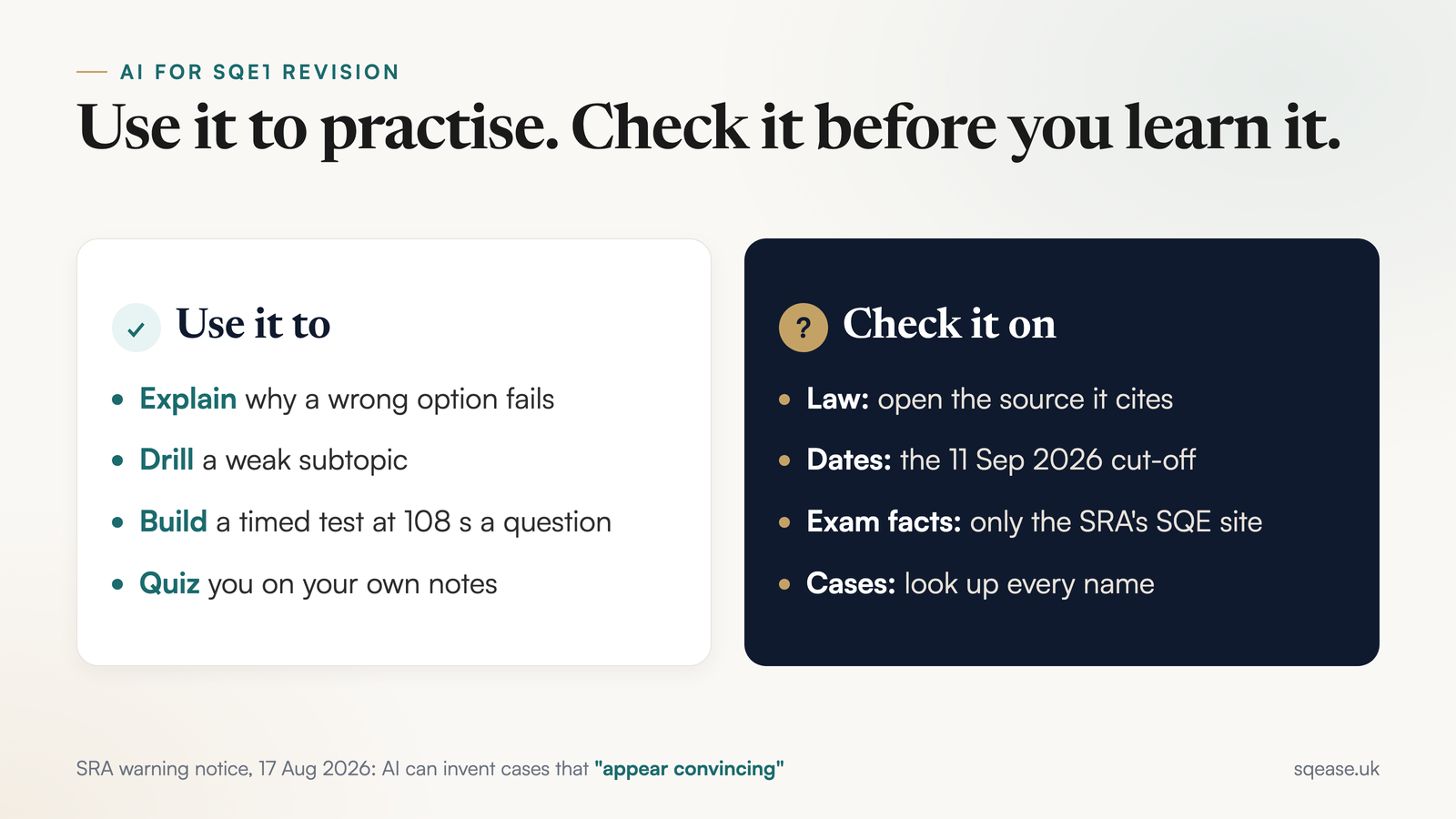
- Explaining a wrong option. SQE1 questions have five options, and the SRA says "each of the five options is plausible, but only one is correct" (SRA, single best answer questions). Asking why the option you chose fails, in a different way each time, is where a patient tutor helps most.
- Drilling a weak subtopic. Short sets of questions on one area, with immediate feedback, turn a gap into practice.
- Building a test. A set mixed across your weak subjects, timed at the January 2027 pace of about 108 seconds a question, saves an hour of planning.
- Turning notes into recall prompts. Asking an AI to quiz you on your own notes is low risk, because you hold the source.
What these have in common: the AI is working on material you can see, or the stakes of a mistake are low. That changes when it starts to state the law.
Where AI misleads
AI misleads in three ways that matter for SQE1. First, it states rules with no date. Every sitting examines law and practice up to a fixed cut-off, which for January 2027 is 11 September 2026. An answer with no date may describe the law before or after it.
Second, it repeats exam facts that have changed. The SRA cut each SQE1 paper from 180 to 170 questions from January 2027 (SRA, 10 September 2026), but the web, which AI tools draw on, is still full of the old numbers.
Third, it invents. The SRA's warning notice on the misuse of AI says AI tools can generate "fictitious cases, references or seemingly factual assertions that may appear convincing despite having no basis in fact". In R (Ayinde) v Haringey LBC [2025] EWHC 1383 (Admin), the Divisional Court said such tools "may cite sources that do not exist". A case name you cannot find is a case you should not learn.
What we found when we checked AI answers
We check what AI search tools say about SQE1, because candidates ask them first. The table shows four answers we saw on Google, each beside what the SRA says. Three match the old exam or an old page, not January 2027. The fourth frames the pass mark as a percentage, which the SRA does not use.
| Question | What we saw (date) | What the SRA says |
|---|---|---|
| How many SRA sample questions are there? | Google AI Overview: 90 (26 Oct) | 220: 90 original and 130 pre-tested |
| How long per question? | Google AI Overview: 1.7 minutes (21 Oct) | About 1.8 minutes, or 108 seconds, from January 2027 |
| How many questions per session? | Google AI Overview: 90 (21 Oct) | 85 from January 2027 |
| What is the pass mark? | Google "People also ask": "Is 60% enough to pass SQE1?" (26 Oct) | A scaled score of 300 out of 500, always; the raw mark behind it is set for each paper |
Part of the cause is visible. The SRA's own April 2025 sample paper, which says "approximately 1.7 minutes per question", still appears in Google's results for the timing question. AI search tools build their answers from pages that rank, so an old page that ranks can become an old answer.
Five checks before you trust an AI answer
None of these takes more than a minute, and together they catch most of the failures above.
- Ask for the source, then open it. For exam facts, the only source is the SRA's SQE site. For law, it is legislation.gov.uk or the judgment itself.
- Check the date. Is the rule in force on 11 September 2026, the January 2027 cut-off? Rates and thresholds change from year to year.
- Look up every case name. Search the National Archives' Find Case Law or a law report. If it is not there, do not learn it.
- Check it against the specification. If a rule is not in the SQE1 Assessment Specification, it is not on the exam, however well it is explained.
- Argue the other side. Ask why each of the other four options might be right. If the answer flips as soon as you push back, it was a guess.
Do AI-written questions appear in the real SQE?
No, according to Kaplan, which runs the exam for the SRA. In April 2025 a Kaplan spokesperson told Legal Cheek that "Kaplan employs a team of solicitors who write, edit and review SQE questions" and that "we have not used any questions generated by AI in any SQE assessments". Kaplan said AI "may be used as one of a number of tools to assist the team with question development", but that every question used in SQE assessments is drafted by solicitors of England and Wales.
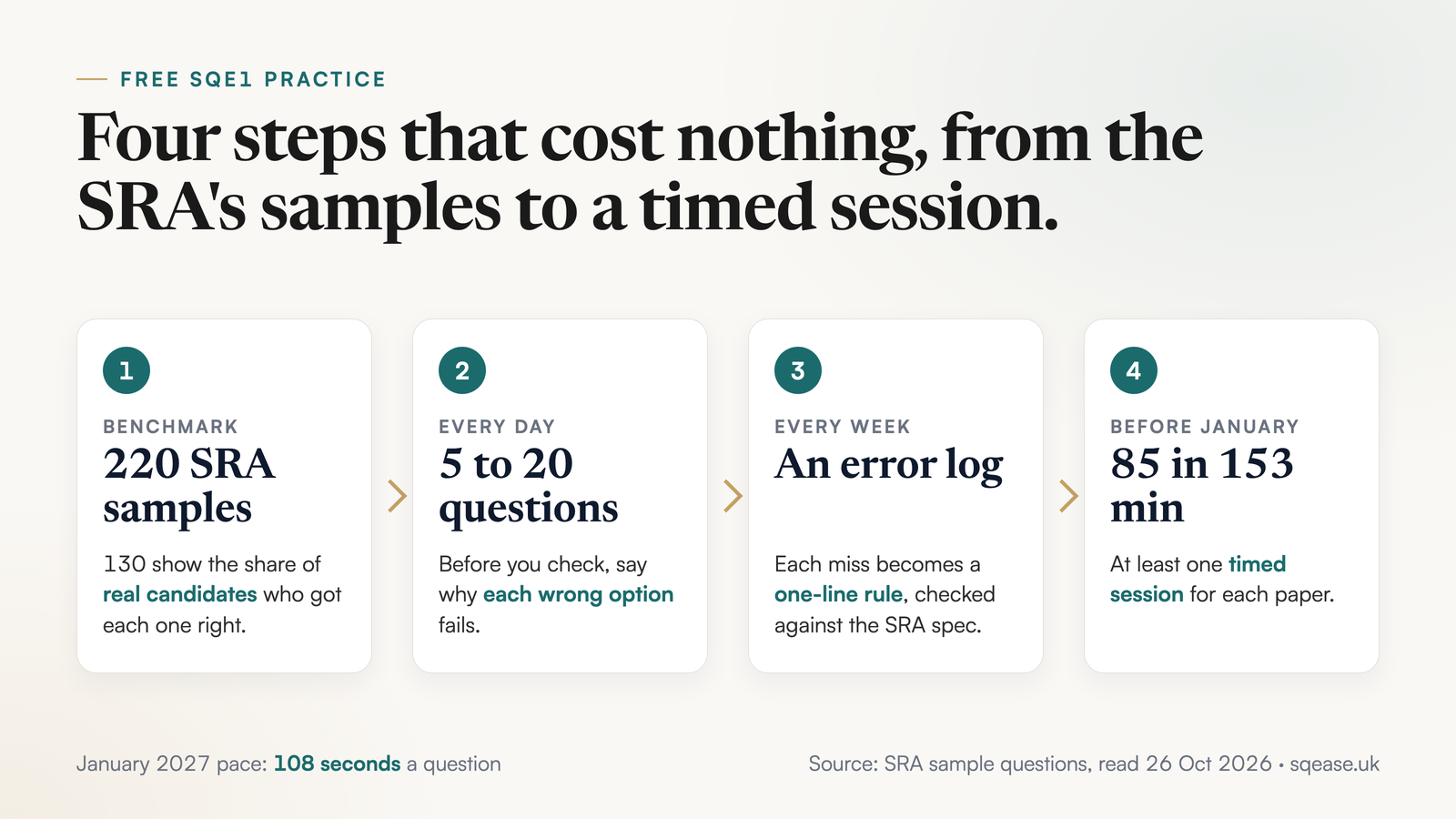
That matters for how you use AI-written practice questions. They can be good practice, but they are not samples of the exam. The SRA's 220 published samples are the only questions you can be sure match it, and many of them have appeared in live assessments. SQE1 itself is closed book, so AI can help only before the day, never in the room.
Are AI-written practice questions worth using?
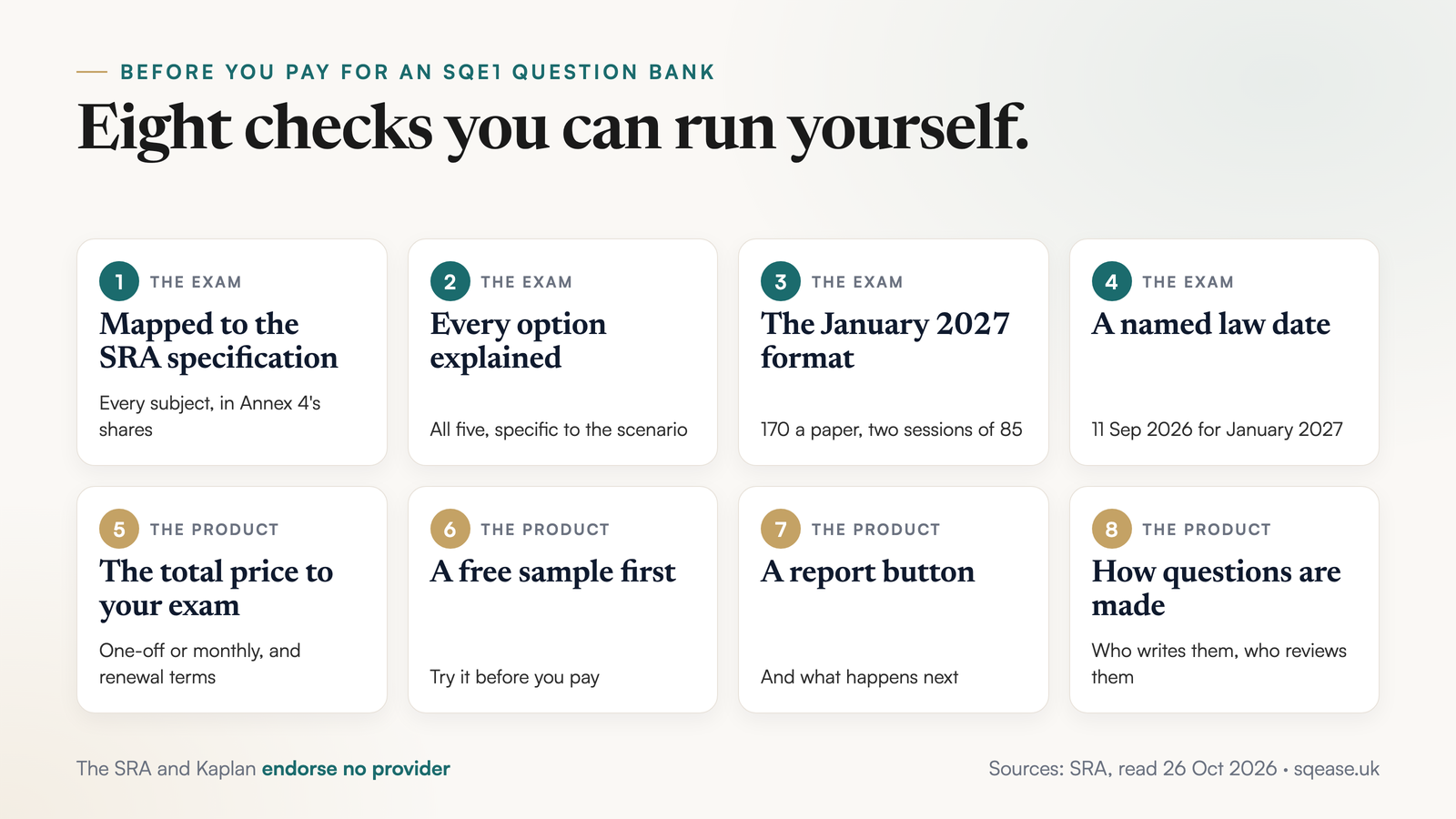
They can be, if the bank behind them is honest about how they are made and checked. An AI-written question can be just as accurate as a human-written one, or less, and you cannot tell which from the question alone. What you can judge is the bank: whether it maps to the specification, explains every option, follows the January 2027 format, names its law date, and lets you report a mistake. Our eight checks for any SQE1 question bank sets those out, with a 36-minute test against the SRA's samples. For free sources to test with, see our guide to free SQE1 practice questions.
How Lex, SQEase's AI tutor, works
SQEase, the platform I run, has an AI tutor called Lex, so this section is about our own product. Lex explains why an option you chose is wrong, answers questions on the law, and on paid plans builds practice tests for you. It answers from a curated legal knowledge base, and its "Research now" option searches the web and shows the sources it used as links. The free plan includes 15 Lex messages a day.
Two limits, stated plainly, because the checks above apply to Lex too. Lex's everyday answers do not show their sources; only "Research now" does. And Lex does not tell you which sitting's law it is answering to. So treat Lex as you would any AI tutor: use it to understand, and check any rule you plan to rely on against the SRA or the law itself. Our plans, including the free plan, are on the pricing page.
Questions candidates ask
Can I use ChatGPT to revise for SQE1?
Yes, for explaining, quizzing and planning, with the five checks above. Be most careful with exam facts and dates, which changed for January 2027, and with any case it names.
Can AI predict SQE1 questions?
No. The SRA runs several papers in each sitting and randomises the order of questions and options, so no tool can know what will be on your paper. What the SRA does publish is the specification and its blueprint of how much each subject counts.
Is it safe to paste my notes into an AI tool?
Your own revision notes are usually low risk, but check the tool's terms on whether what you type is stored or used for training. The SRA's warning notice says both paid and free AI tools may lack the safeguards needed for confidential information, so never paste anything from work.
How this was written: Finlay Salisbury wrote and edited this post. AI tools helped with research and drafting. Every legal and factual point was checked by him against the linked primary sources. He is not a solicitor, and this is study information, not legal advice.
Disclosure: I run SQEase, a paid SQE1 practice platform, so I have a commercial interest in how candidates prepare. This piece relies on the SRA's published sources, linked throughout, and does not rank or review other providers. SQEase's SQE1-style practice questions are written by AI and checked by automated multi-model processes. They are not reviewed by a solicitor and are not SRA or SQE1 exam questions.