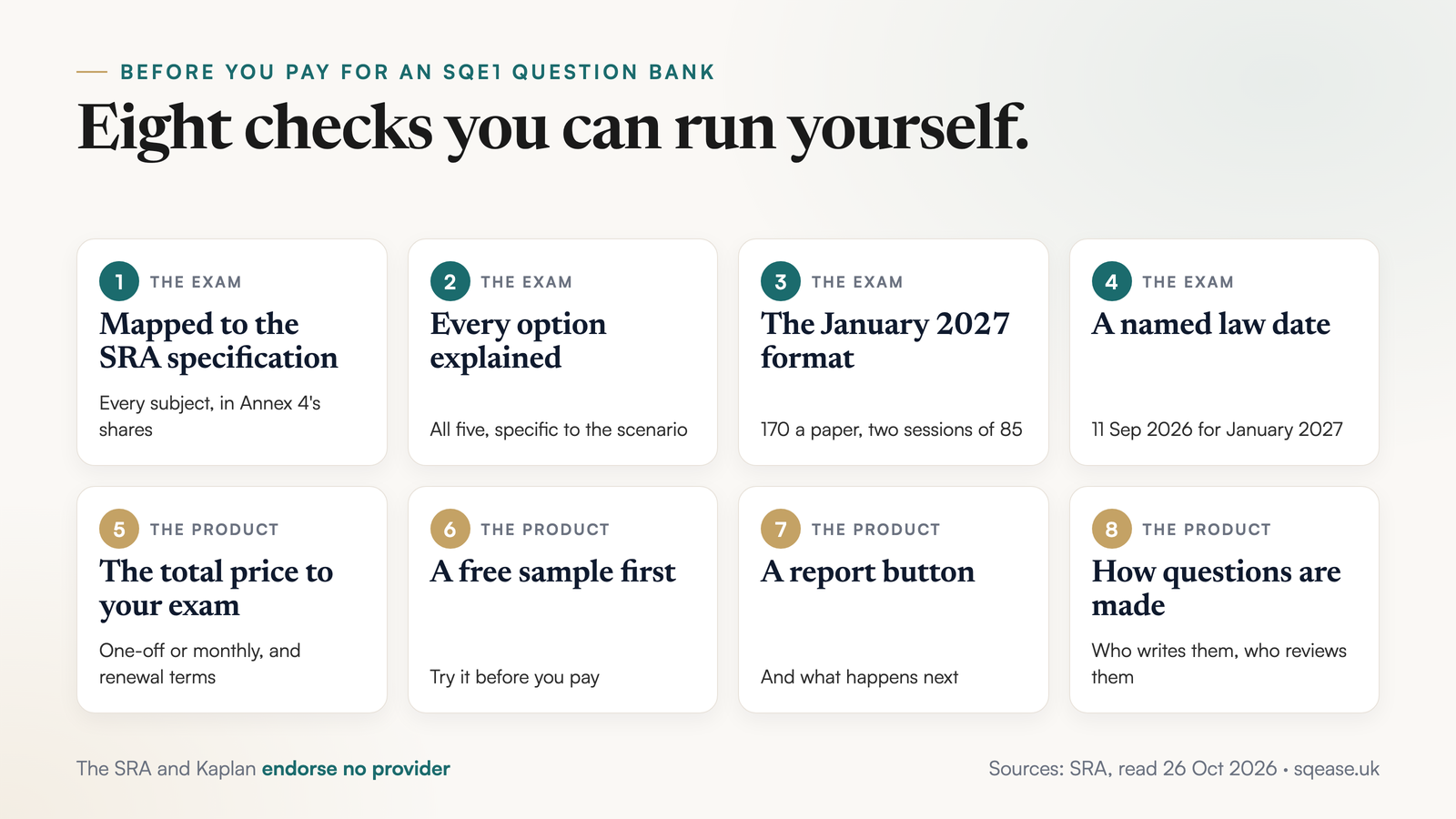
Judge an SQE1 question bank by eight checks you can run yourself, most of them against the SRA's published rules. The SRA and Kaplan do not accredit or endorse any provider, so a bank's description of itself is not evidence. This checklist names no winner and ends with a 36-minute test against the SRA's own sample questions.
Why a checklist, not a ranking
Search for "best SQE1 question bank" and most of the "best" lists you find are published by companies that sell one. That does not make them wrong, but it makes them a poor place to start. The SRA states that "neither Kaplan nor the SRA regulates, accredits or endorses training providers" (SRA, dates and booking windows), so no bank is officially approved, whatever its marketing says.
The SRA's own guide to choosing an SQE training provider (updated 28 January 2026) points the other way: get information about quality, about the people behind the training, and about the terms you sign up to. The eight checks below turn that advice into questions you can answer for any bank in an evening, including ours.
1. Is it mapped to the SRA specification?
A good bank tells you which part of the SQE1 Assessment Specification each question tests. The specification is the SRA's list of everything SQE1 can examine, and its Annex 4 blueprint sets each subject's share of a paper: 14 to 20% for most subjects, 12 to 16% for Legal Services, and up to 20% for Ethics and money laundering together.
To check, filter the bank by subject. Are Legal Services and Solicitors Accounts there, or only the popular subjects? Is Ethics woven into scenarios across subjects, as the SRA tests it, or kept in a separate corner? A bank that leans heavily on one or two subjects leaves gaps the exam will find.
2. Does it explain every option, not just the right one?
The SRA describes every SQE1 question as five options where "each of the five options is plausible, but only one is correct" (SRA, single best answer questions). Marks are won by knowing why the near-miss options fail, so an explanation of the right answer alone teaches half the lesson.
Open a free question and read the explanations. Look for one for each of the five options, and check that each one is specific to the scenario ("the buyer has not yet exchanged contracts, so…") rather than a general line such as "this option is incorrect". If the wrong options are explained in a sentence of boilerplate, the bank is teaching you answers, not reasons.
3. Does it match the January 2027 format?
From January 2027, each SQE1 paper is 170 questions, sat as two sessions of 85, with 2 hours 33 minutes a session (SRA, sample questions page). Each session tests its own subjects, and the pace is about 108 seconds a question. Until July 2026 it was 180 questions a paper and 90 a session.
Some prep material still describes 180-question mocks. A mock in the old shape trains the old pace and mixes subjects that will no longer share a session. Ask whether the bank's timed mocks are 2 × 85, whether each session holds the right subjects, and what time limit they use. Our post on what changed in January 2027 sets out the new session split.
4. Which law date is it written to?
Every SQE1 sitting examines law and practice up to a fixed date: four calendar months before the first assessment. For the January 2027 sitting that date is 11 September 2026, and for July 2027 it is 12 March 2027 (SRA, dates and booking windows).
Law moves: rates, thresholds and procedure change every year. A question written to last year's law can teach you the wrong answer with complete confidence. Ask the provider which cut-off date its bank is written to, and how it updates questions when the law changes. A bank that cannot name a date has not thought about it, and that is worth knowing before you pay.
5. Is the price one-off or monthly, and for how long?
SQE1 banks are sold in three main ways: a one-off price until your sitting, a fixed-length pass, or a monthly subscription. None is better in itself. What matters is the total you will pay between today and your exam, and what happens after it.
Work out that total for your own sitting date, then read the terms. Does a monthly plan renew automatically? Can you cancel online? Is there a refund window? Does access end at the exam, or run to a resit? The SRA's guide asks candidates to be happy with a provider's terms and to understand their consumer rights before signing up. Our dated table of SQE1 prep prices sets out the published prices, from free plans to full courses.
6. Is there a free trial or sample?
Never pay for a bank you have not tried. Most SQE1 providers offer something free: a daily set, a diagnostic, a few topics or a free mock. That is enough to run checks 1 to 3 and the 36-minute test below.
Read the terms of any free trial before you start it. Some trials take payment details and become a paid subscription automatically unless you cancel; that is common and lawful, but you should know the date it renews and how to stop it. A free plan with no end date is a different thing from a trial, and is often the better way to test a bank. Our guide to free SQE1 practice questions lists the free offers as published.
7. Can you report a wrong question?
Every question bank contains mistakes, whoever writes it. What separates banks is what happens when you find one. Look for a report button on the question itself, not just a contact form, and ask what happens next.
The useful answers are specific: the question is withdrawn while it is checked, you hear back, and the fix is made to the question rather than noted in a forum. A bank that takes reports seriously gets better every week; one that does not will serve the same wrong answer to every candidate who meets it. If a provider has no way to report a question, assume errors stay in.
8. Is it honest about how its questions are made?
Ask who writes the questions, whether a qualified solicitor reviews each one, and whether AI is used. All three answers can be fine; what matters is that you get them. For the live exam, Kaplan, which runs SQE1 for the SRA, told Legal Cheek in April 2025 that "Kaplan employs a team of solicitors who write, edit and review SQE questions" and that it has "not used any questions generated by AI in any SQE assessments".
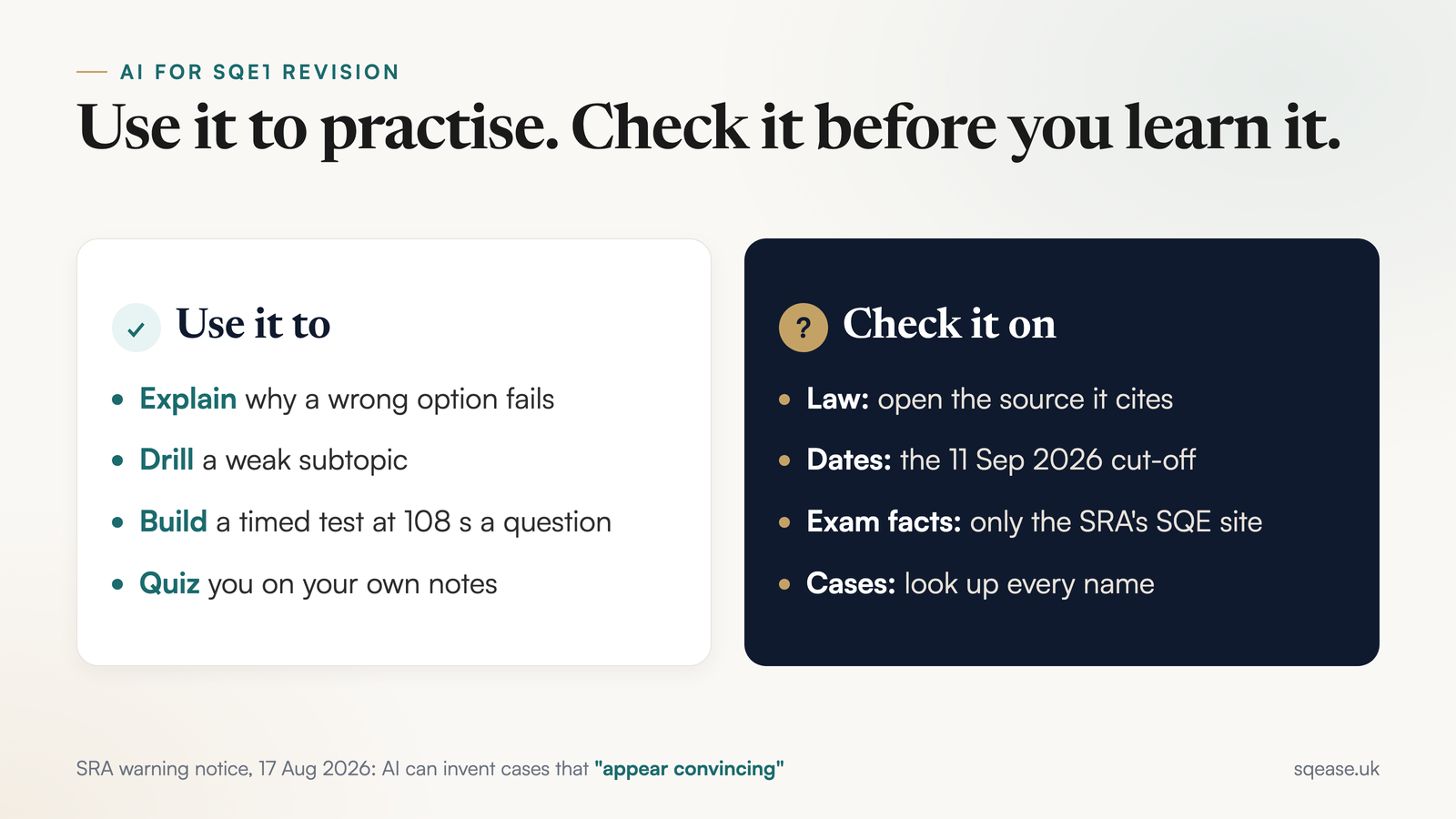
Two phrases deserve a second look. "SRA-approved" or "official" on a prep product cannot be true, because the SRA endorses no provider. "Real exam questions" fits only the SRA's own published samples, many of which have appeared in live assessments. A bank that is plain about its method, including its limits, is easier to trust than one that only praises itself. For where AI helps revision and what to check, see AI for SQE1 revision.
Test any bank against the SRA's samples in 36 minutes
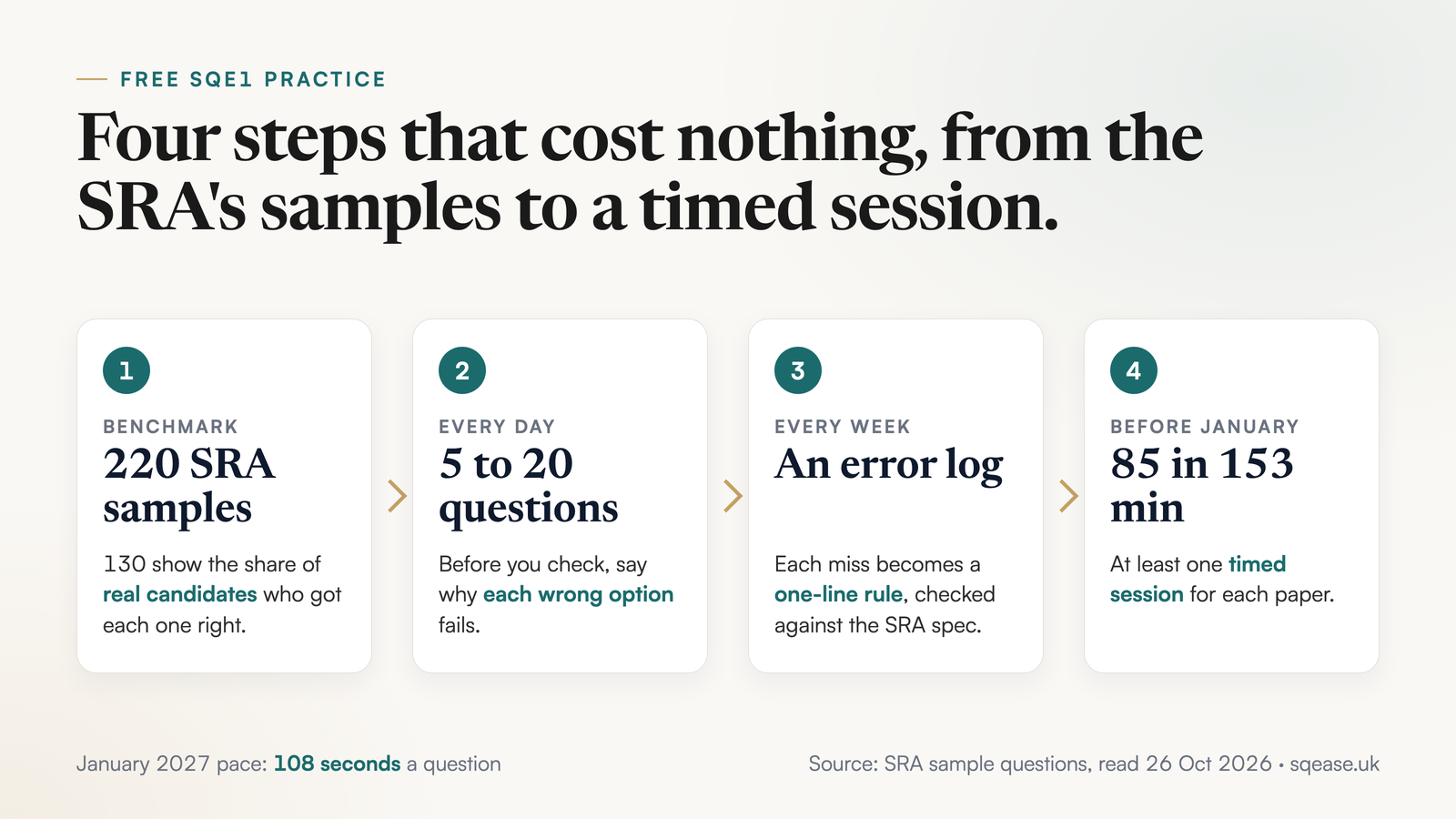
No description of a bank, ours included, replaces trying it. This test uses the SRA's 130 pre-tested sample questions, which have all been used in live SQE1 assessments.
- Take 10 free questions from the bank you are judging, in exam mode, and 10 SRA pre-tested questions from the same subjects.
- Answer all 20 under time: 36 minutes, which is the January 2027 pace of about 108 seconds a question (our arithmetic).
- Compare length. Live SQE1 questions average 206 words, and the pre-tested samples 208. Exam-style questions much shorter than that test recall, which has its place, but the SRA says SQE1 questions "do not assess simple recall".
- Compare the wrong options. In the SRA's questions, each one is tempting for a reason. If the bank's wrong options are obviously wrong, it is easier than the exam.
- Look for a second answer. If you can argue that two options are equally right in a bank question, the question is flawed.
- Read the bank's explanations against check 2.
Running the test on SQEase
SQEase is the SQE1 practice platform I run, so this section is about our own bank and you should weigh it accordingly. Our free plan gives five SQE1-style questions a day, each with an explanation of the correct option and every wrong one, which is enough to run the test above on us. Our questions are written by AI and checked by automated processes; they are not reviewed by a solicitor, and they are not SRA or SQE1 exam questions. You can report a question from the exam screen in one tap, and a report re-runs our automated checks; anything that touches the answer goes to a person. Our plans and prices are on the pricing page.
Questions candidates ask
Is a bigger question bank better?
Not by itself. A bank's size tells you nothing about whether its questions match the specification, the format or the law date. A smaller bank whose questions pass checks 1 to 4, with full explanations, will teach you more than a larger one that fails them.
Do I need a question bank if I have the SRA samples?
The SRA's 220 samples are free and the closest thing to the real exam, but the SRA says they "are not designed to be a full mock exam" and do not cover every topic. They also give no explanations. Most candidates use them as a benchmark alongside a bank, not instead of one.
Does the SRA endorse any question bank?
No. The SRA states that neither it nor Kaplan regulates, accredits or endorses training providers. A provider can map its questions to the SRA specification, but not claim the SRA's approval.
How this was written: Finlay Salisbury wrote and edited this post. AI tools helped with research and drafting. Every legal and factual point was checked by him against the linked primary sources. He is not a solicitor, and this is study information, not legal advice.
Disclosure: I run SQEase, a paid SQE1 practice platform, so I have a commercial interest in how candidates prepare. This piece relies on the SRA's published sources, linked throughout, and does not rank or review other providers. SQEase practice questions are written by AI and checked by automated multi-model processes. They are not reviewed by a solicitor and are not SRA or SQE1 exam questions.