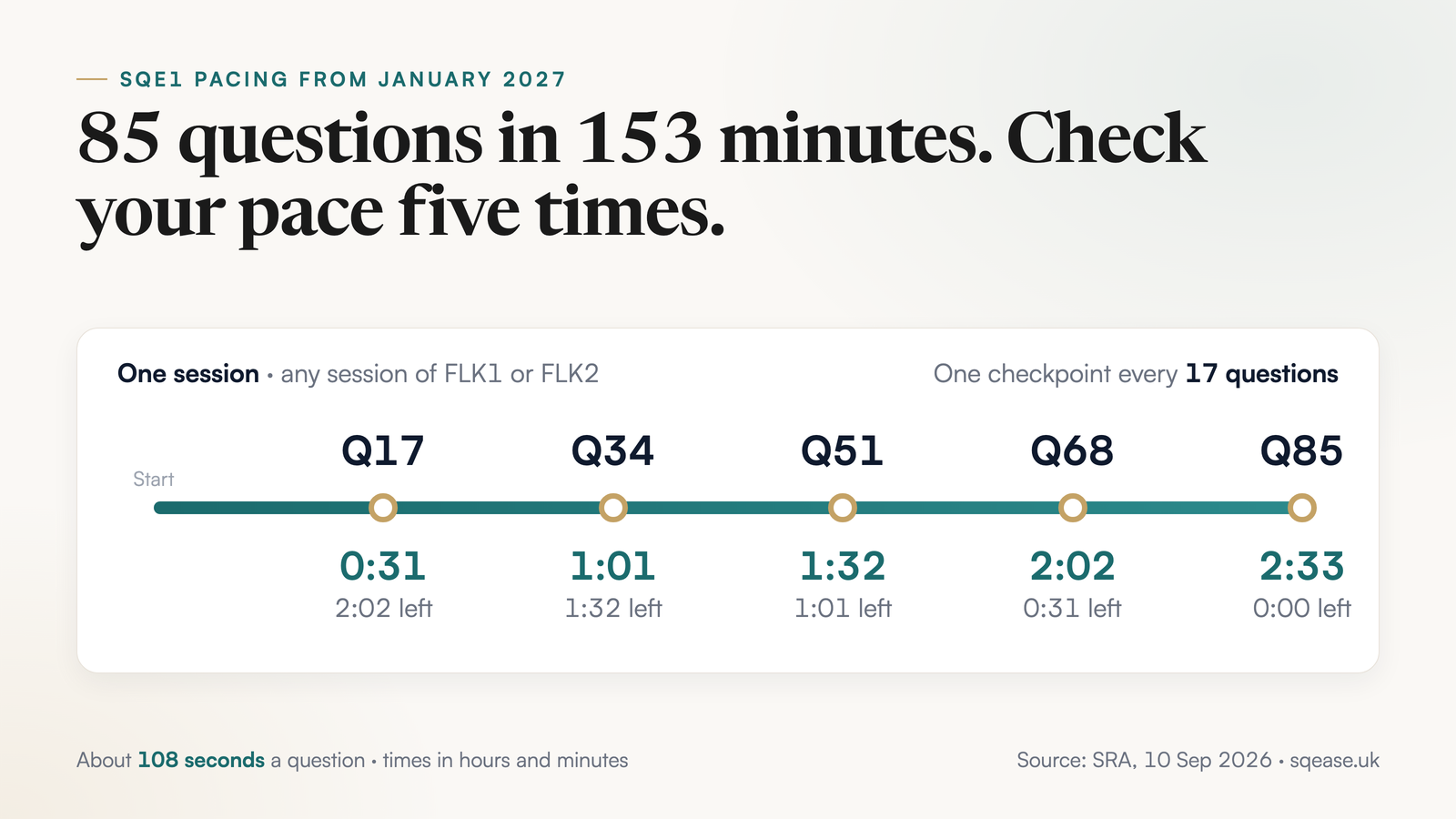
You get about 108 seconds a question in SQE1 from January 2027: 153 minutes for each session of 85. That is six seconds more than before, under the SRA's January 2027 format. About half of it goes on reading the question once, so the skill that matters is checking your pace a few times, not on every question.
How long do you get for each SQE1 question?
Each SQE1 session gives you 153 minutes for 85 questions, which is 108 seconds a question on average. The SRA kept the session at 2 hours 33 minutes when it cut each paper from 180 questions to 170, so the time for each question went up. Its sample questions page describes the new pace as "about 1.8 minutes per question, though some questions may require more or less time".
The figure is the same in all four sessions. Both sessions of FLK1 and both sessions of FLK2 are 85 questions in 153 minutes, with a 60-minute break between the two sessions of a paper. Some study guides, and an older SRA sample paper, still describe 90-question sessions and about 1.7 minutes a question. They were written before the change.
| Until July 2026 | From January 2027 | |
|---|---|---|
| Questions per session | 90 | 85 |
| Time per session | 2 h 33 min | 2 h 33 min |
| Average time per question | about 102 seconds (1.7 min) | about 108 seconds (1.8 min) |
The 108 seconds is an average, not a limit on each question. The clock runs for the whole session, so a hard question can take three minutes; the time simply comes out of the questions after it.
Five checkpoints for an 85-question session
The simplest plan is to check the clock every 17 questions. Eighty-five is five lots of 17, and 17 questions at 108 seconds take about 30½ minutes, so the checkpoints fall roughly every half hour.
| Checkpoint | Questions answered | Time used | Time left |
|---|---|---|---|
| 1 | 17 | 31 min | 2 h 02 min |
| 2 | 34 | 1 h 01 min | 1 h 32 min |
| 3 | 51 | 1 h 32 min | 1 h 01 min |
| 4 | 68 | 2 h 02 min | 31 min |
| 5 | 85 | 2 h 33 min | 0 |
The "time left" column is the one to learn. The SRA's SQE1 sample test on Pearson VUE shows a timer with the time remaining in the session, and watches are not allowed in the room, so that timer is your only clock. You are given an erasable whiteboard notepad: one approach is to write 17, 34, 51 and 68 with their times left (2:02, 1:32, 1:01, 0:31) when the session starts, and glance at them only when you reach those questions.
Where the 108 seconds go: reading and thinking
About half of each 108 seconds goes on reading. The SRA reports that questions in live SQE1 assessments have averaged 206 words, so each session asks you to read about 17,500 words. A 2019 review of 190 reading studies put typical adult silent reading of non-fiction at 238 words a minute, and reported slower rates, around 200 words a minute, when people read to answer a multiple-choice test. On those figures, one careful read of an average question takes between 52 and 62 seconds, which leaves between 46 and 56 seconds to weigh five options and choose.
That is our estimate, not an SRA figure, and dense facts, dates and figures slow most people down further. But it explains two things. First, the January 2027 change gives all six extra seconds to thinking, not reading: the questions did not get shorter. Second, reading a whole question twice costs 104 seconds or more, which is the whole budget.
So read once, with a purpose. The SRA describes three parts to every question: the stem (the scenario), the lead-in, which is the sentence that sets out the question to be answered, and five options, only one of them correct. In our view, reading the lead-in first is the cheapest habit to build: you then read the facts knowing what they are for.
Should you aim faster than 108 seconds?
Yes, if you want time at the end to revisit questions. The SRA's sample test lets you flag a question for review and return to any question in that session from a review screen. That time has to come from somewhere, because 108 seconds a question uses the whole session.
Aiming for about 100 seconds a question finishes the 85 in about 2 hours 22 minutes and leaves around 11 minutes for flagged questions. At 100 seconds, the checkpoints move to roughly 28 minutes, 57 minutes, 1 hour 25 minutes and 1 hour 53 minutes. Spend the spare minutes where a second look can change the answer, such as a calculation, a date or a time limit, rather than re-reading answers you were already sure of.
The cost of one stuck question is easy to underestimate. Four minutes on a single question uses the time of more than two average questions. Flagging it and moving on is usually cheaper than finishing it there and then.
What to do if you fall behind
If you reach a checkpoint behind time, the fix is to change what you spend time on, not to read faster. This is our advice, built on the SRA's rules:
- Answer every question. Under the SRA's marking policy, each correct answer earns one mark and no marks are deducted for a wrong one. A blank can never score, so a reasoned guess always beats one.
- Set a cut-off for hard questions. If a question has taken about two minutes and you are behind, choose the strongest option you have, flag it and move on.
- Stop re-reading what you were sure of. This is where most recoverable time sits.
- Keep any unscheduled break short. If you leave the room during a session, the assessment timer is not stopped.
- Use the last few minutes to fill gaps. Check the review screen for unanswered questions before the timer reaches zero.
The same plan works if you are ahead: bank the time, and spend it on flagged questions at the end.
How to practise the pace
Pace is rehearsed, not read about. The SRA itself notes that working through its sample questions cannot fully replicate a timed, closed-book session. Three habits make practice closer to the day:
- Time mocks at 85 questions in 2 hours 33 minutes. A 90-question session in the same time trains the old pace of about 102 seconds, and a mixed 180-question paper trains a shape that no longer exists. Our post on what changed in SQE1 from January 2027 covers the session subjects.
- Drill in blocks of 17. Seventeen questions in about 31 minutes is a short, repeatable session that builds the checkpoint habit.
- Measure your time per question, not just your score. A score tells you what you knew; your time per question tells you whether you would have finished.
How SQEase times practice
When the SRA announced the change, we rebuilt the SQEase simulation around it. Each paper is two sessions of 85, and each session has its own countdown clock of 2 hours 33 minutes, set from 108 seconds a question. Every timed test in SQEase uses the same 108 seconds a question, whatever its length. Within a session you can move between questions and tag one to come back to, and once Session 1 ends you cannot reopen it.
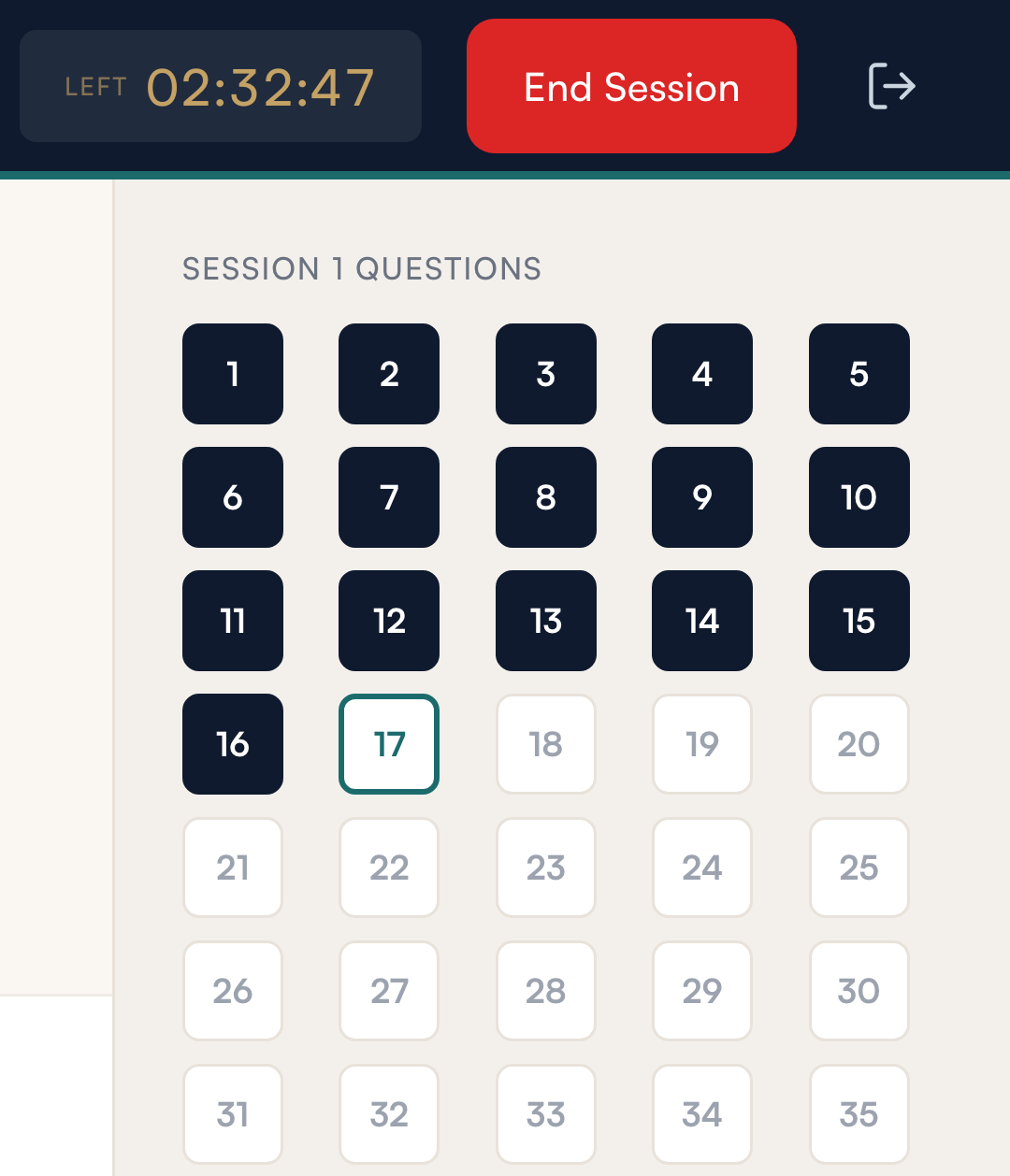
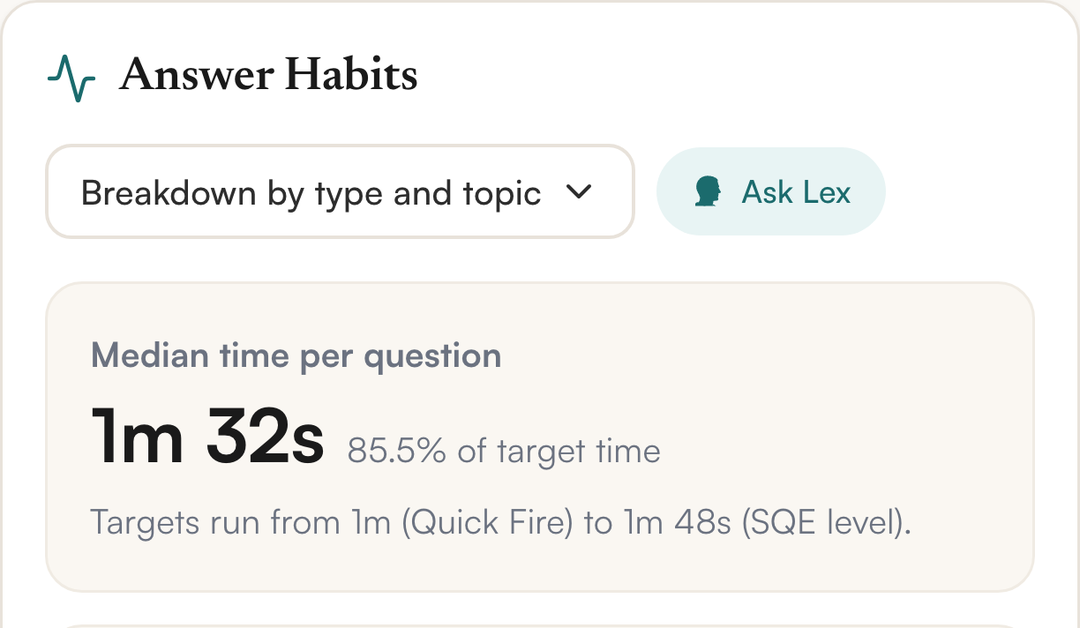
We kept the web clock plain: there are no pace warnings during a session, and your pace is shown afterwards. On the Core, Pro and Ultra plans, the results show your average time per question for each question style against its budget, and the share of questions answered within it. On Ultra, Answer Habits tracks your typical time per question against a target for each style, from 1 minute for Quick Fire questions to 1 minute 48 seconds at SQE level. On iPhone, a timed test shows a countdown that turns amber at five minutes left and red at one; the iPhone app uses the same account as the web.
One limit is worth stating plainly. An average hides the spread: a short question on one rule and a long scenario full of dates and figures do not take the same time, and in a randomised session you cannot know which is next. The checkpoints absorb that variation; a per-question target cannot.
Questions candidates ask
Is it still about 1.7 minutes a question?
No. From January 2027 it is about 1.8 minutes, or 108 seconds, because each session has 85 questions instead of 90 in the same 2 hours 33 minutes.
Is the timing the same for FLK1 and FLK2?
Yes. Every session of both papers is 85 questions in 2 hours 33 minutes.
Does the SQE1 timer count up or down?
Down. In the SRA's sample test, the timer shows the time remaining in the session.
Can you go back to a question?
Within a session, yes. The SRA's sample test lets you flag questions, see a review screen and return to any question in that session.
Does the clock stop if you leave the room?
No. A trip out of the room during a session is an unscheduled break, and the timer keeps running.
Is there a break between sessions?
Yes. A 60-minute break follows Session 1, and the SRA asks you to be back within 50 minutes to re-register for Session 2.
Do wrong answers lose marks?
No. Each correct answer earns one mark and no marks are deducted for incorrect answers, so answer every question.
What happens if you do not finish?
Questions you leave blank earn nothing, and your result depends on how many you answer correctly. If time is running out, put an answer on every remaining question before the timer reaches zero.
If you want to rehearse the pace, the SQEase simulation times each session at 2 hours 33 minutes for 85 questions, with a score for each session at the end.
How this was written: Finlay Salisbury wrote and edited this post. AI tools helped with research and drafting. Every legal and factual point was checked by him against the linked primary sources. He is not a solicitor, and this is study information, not legal advice.