SQEase's free calibration mock is 45 SQE1-style questions: three from each of the 15 SQE1 subjects, at 108 seconds each. It is closed book and takes about 81 minutes. When you finish, Lex, the study assistant inside SQEase, writes you a report on the patterns behind your marks, not only a score for each subject.
What is the SQEase calibration mock?
The calibration mock is a 45-question, closed-book SQE1-style sitting that covers every subject once, in one go. Each of the 15 SQE1 subjects in the SRA's assessment specification gets three questions, Ethics and Professional Conduct included, and every question is a full scenario in the single-best-answer style. The clock gives you 108 seconds a question, the average the SRA gives from January 2027, so the whole mock runs to 81 minutes.
It is in every SQEase account. New candidates are offered it at the end of setup; existing accounts find it at the top of the Home page. You can pause and pick it up later on the same device. For now it is on the SQEase website only and works best on a computer. It is not in the iPhone app yet.
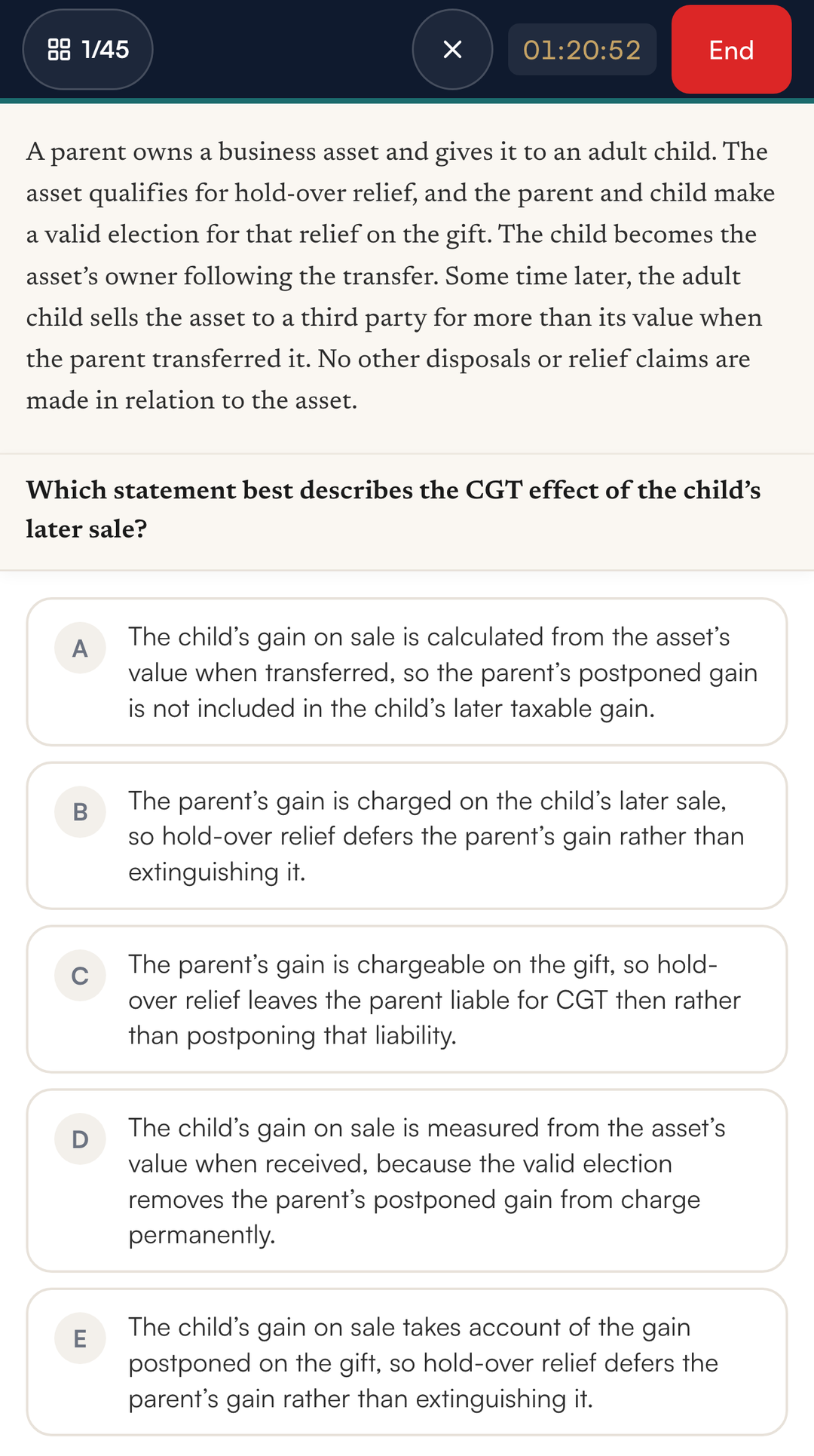
Why a score for each subject can mislead you after a short mock
On any short mock, a score for a single subject is easily moved by luck. Take a candidate who gets 60% of questions right in every subject, and give them three questions per subject. Our arithmetic: the chance of scoring 0 of 3 in one subject is 0.4 × 0.4 × 0.4, about 6%. Across 15 subjects, the chance that at least one shows 0 of 3 is about 63%. The chance that at least one shows a perfect 3 of 3 is about 97%.
So a candidate who is equally good at everything should expect to see roughly three "perfect" subjects and one "zero" subject, by luck alone. Read as a verdict, that result would send them to revise a subject they know and skip three they only half know. The same maths applies to any short mock, ours or anyone else's: a subject breakdown built on a handful of questions is a first read, not a settled answer.
A candidate who gets 60% everywhere has about a 63% chance of scoring 0 of 3 in at least one subject on a 45-question mock.
What to read instead: groups that cut across subjects
The parts of a short mock that carry real evidence are the groups with many answers in them. Some kinds of question turn up in every subject: long scenarios, questions that ask what the solicitor should advise, questions about time limits, procedure or remedies, questions with figures. A group like that can hold eight to fifteen of your 45 answers, from several subjects at once, which is enough to compare with the rest of your answers.
Two more things cut across every subject. Your pace is measured on all 45 questions, not three. Your changed answers are counted across the whole sitting. Neither shows up in a score for each subject, and both cost marks on the day: each correct answer is worth one mark and a wrong one costs nothing, under the SRA's marking policy, so a correct answer changed to a wrong one is a mark given away.
Why 45 questions, three from every subject
We chose 45 so that one sitting reads the whole syllabus and gives enough answers to find these patterns. Three questions from each of the 15 subjects puts every part of SQE1 in the read, and 45 answers in total gives each cross-subject group enough to compare. When we built it, we tried shorter checks first. With 20 questions, every subject on the result screen came back "not enough asked to say", which told a candidate nothing. Three per subject is the least that gives each subject a first reading, and 45 is the total that gives the report its patterns.
The length also keeps it to one evening. At the SRA's average of 108 seconds a question (153 minutes for 85 questions, per the SRA's January 2027 changes), 45 questions take 81 minutes.
What the report shows
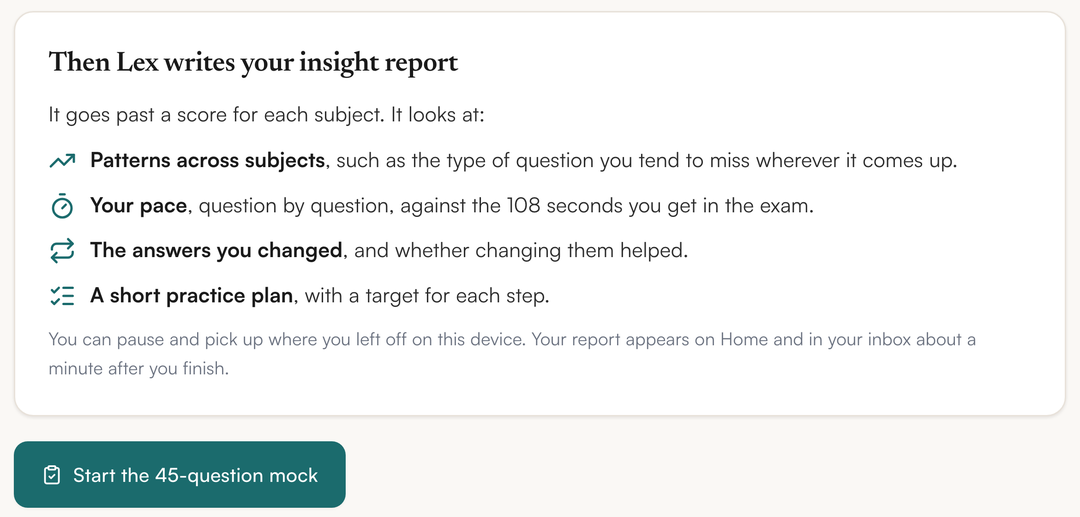
About a minute after you finish, the report appears on your Home page and a summary arrives by email. The numbers and judgements in it are worked out by fixed rules, so nothing is guessed; Lex adds the plain-language reading of what the questions in a pattern have in common. It has six parts.
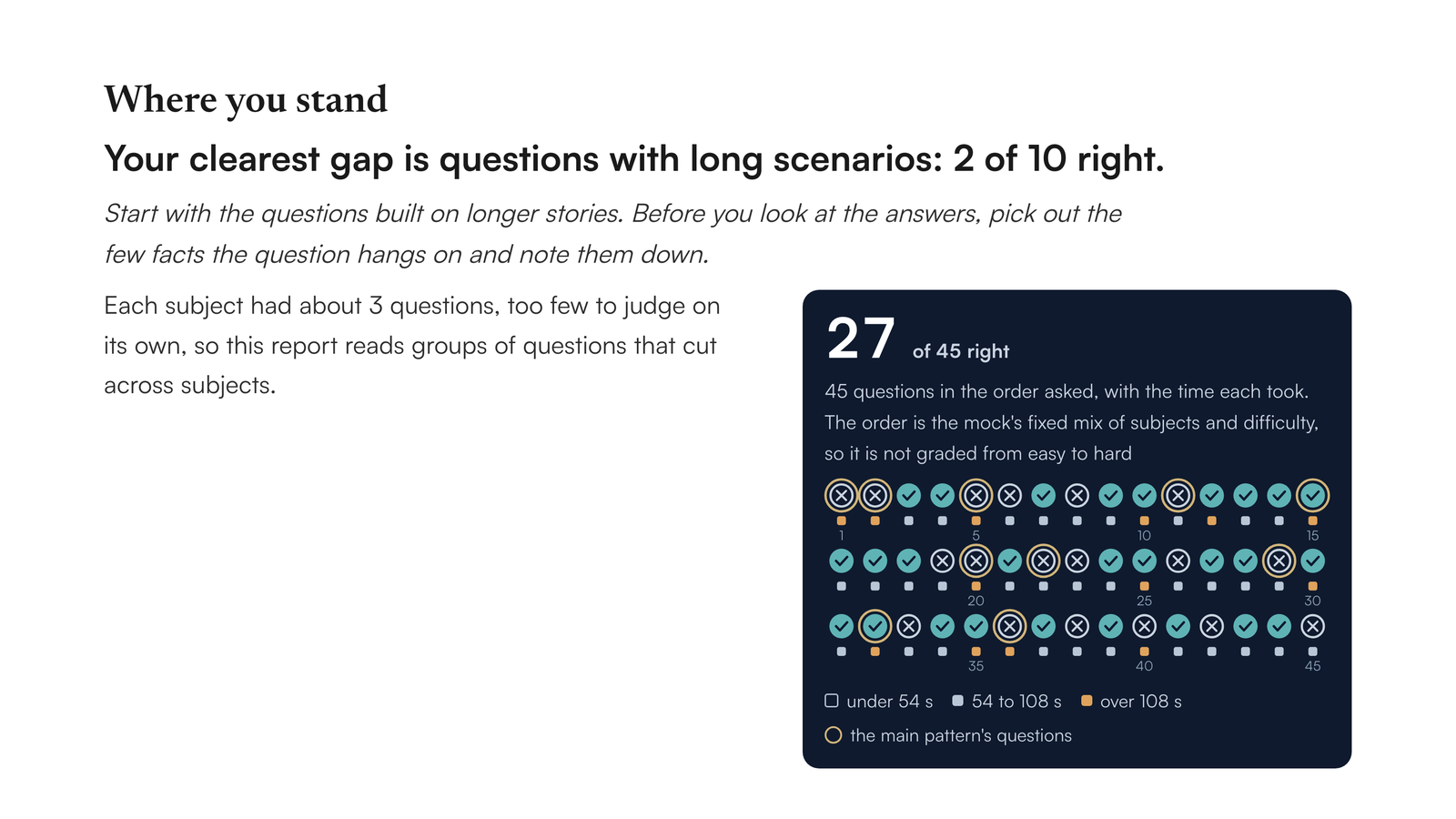
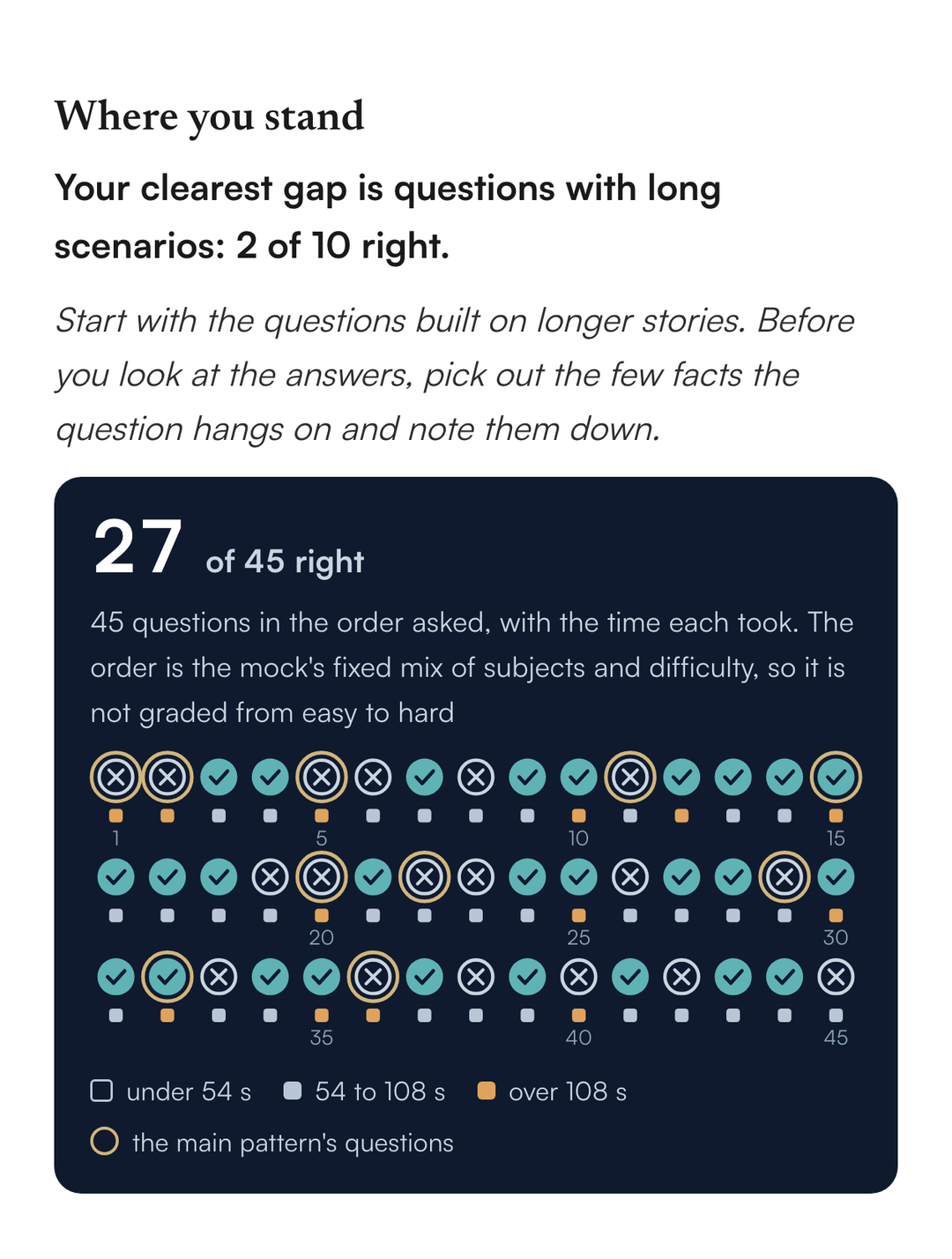
- Where you stand. Your score, a one-line headline and a map of all 45 questions in the order asked, each with the time you took.
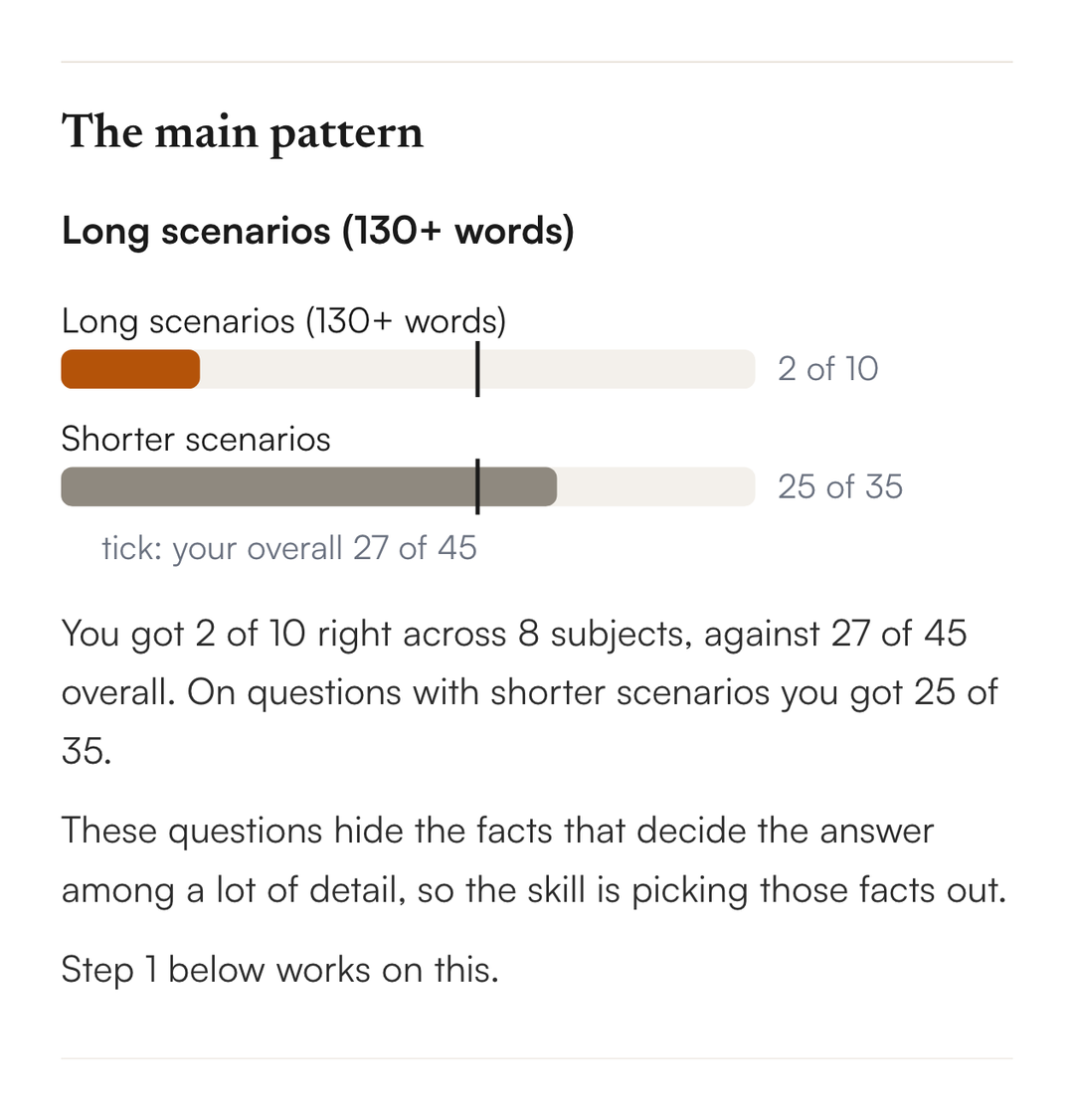
- The main pattern. The group that cost you the most marks, shown against your own overall result.
- Also worth knowing. Smaller findings, marked as an early sign when the evidence is thinner.
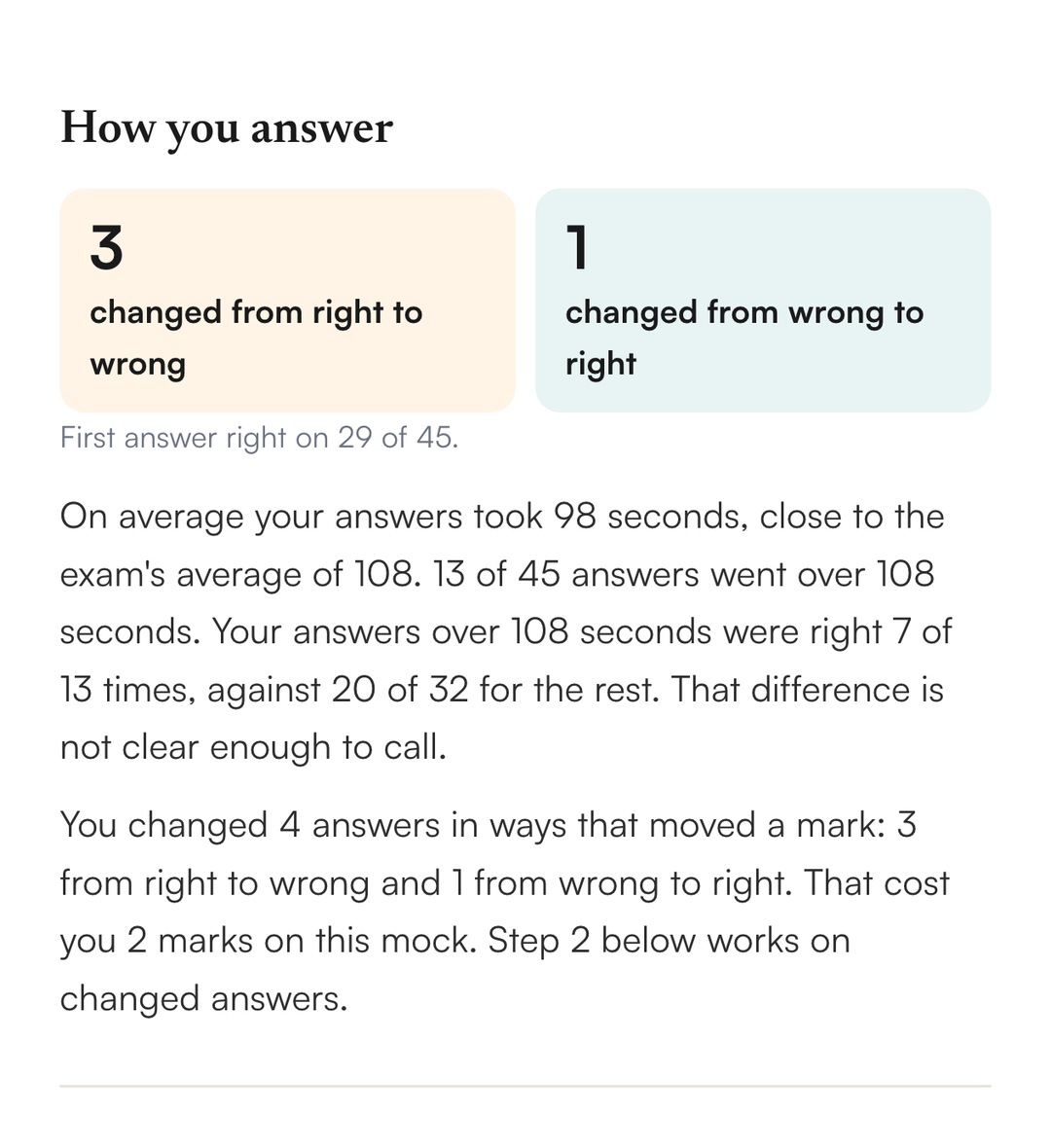
- How you answer. Your average time against 108 seconds, what that pace would mean over an 85-question session, and whether the answers you changed moved marks.
- What you said, and what the mock found. How you said each subject felt, beside how it went.
- Your next steps. Two or three practice sets, each with a target and what each result would mean.
Pace and changed answers, read across the whole sitting
The report reads your pace question by question against 108 seconds, and works out what your average would mean over a full 85-question session of 153 minutes. If your average would leave questions unreached, it says so; if slower answers were the accurate ones, it does not push you to rush. It also counts the answers you changed and whether each change moved a mark, in either direction.
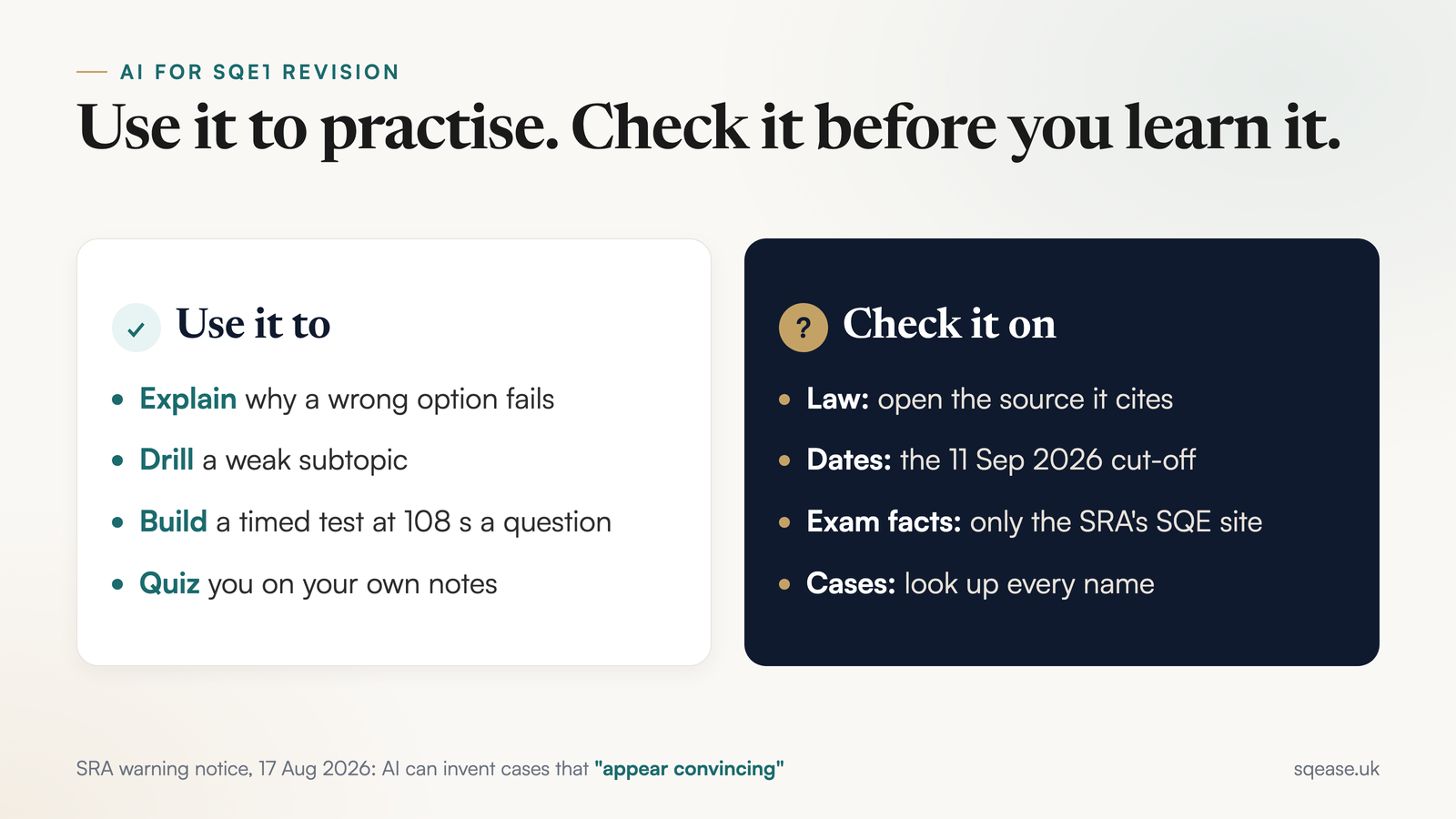
For more on timing, see the 108-second pacing plan for SQE1.
From result to plan: steps with targets
Each step in the report is a practice set, usually 20 questions, aimed at one finding, with a target that tells you what the result means. For example, on a gap in long scenarios: 9 or more of 20 right shows the gap closing, 12 or more puts it level with your overall result, and 8 or fewer suggests it is still a gap to work on. That turns the mock into a short plan you can test, rather than a list of weak topics.
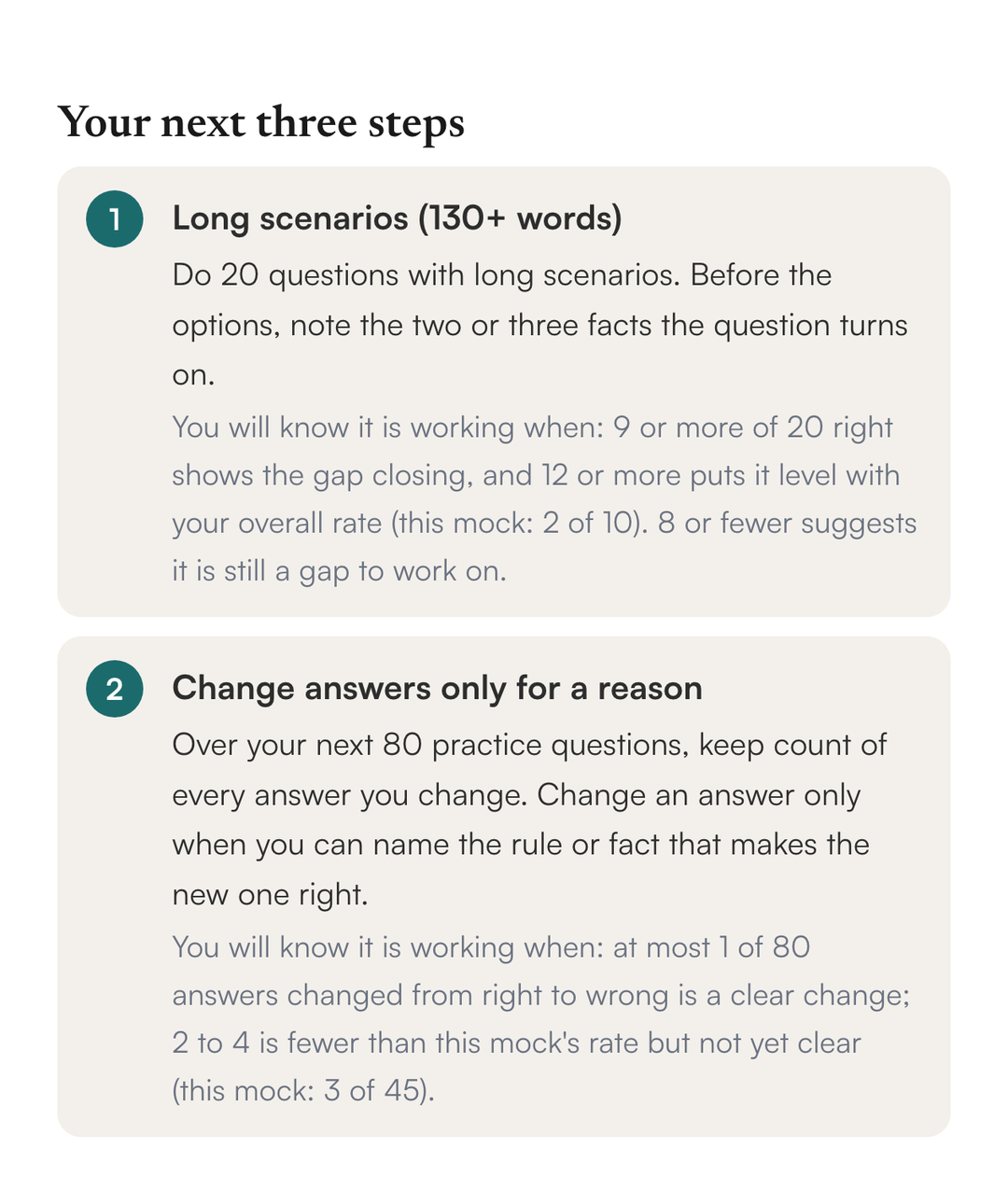
How to use it before the January 2027 sitting:
- Take the calibration mock early, in one sitting, at a computer.
- Read the main pattern first, then pace and changed answers, then the subjects.
- Work through the steps and check each against its target.
- Use the SRA's free sample questions and timed 85-question sessions nearer the date. Where to find free SQE1 practice questions lists them.
Other free SQE1 mocks, as each provider describes them
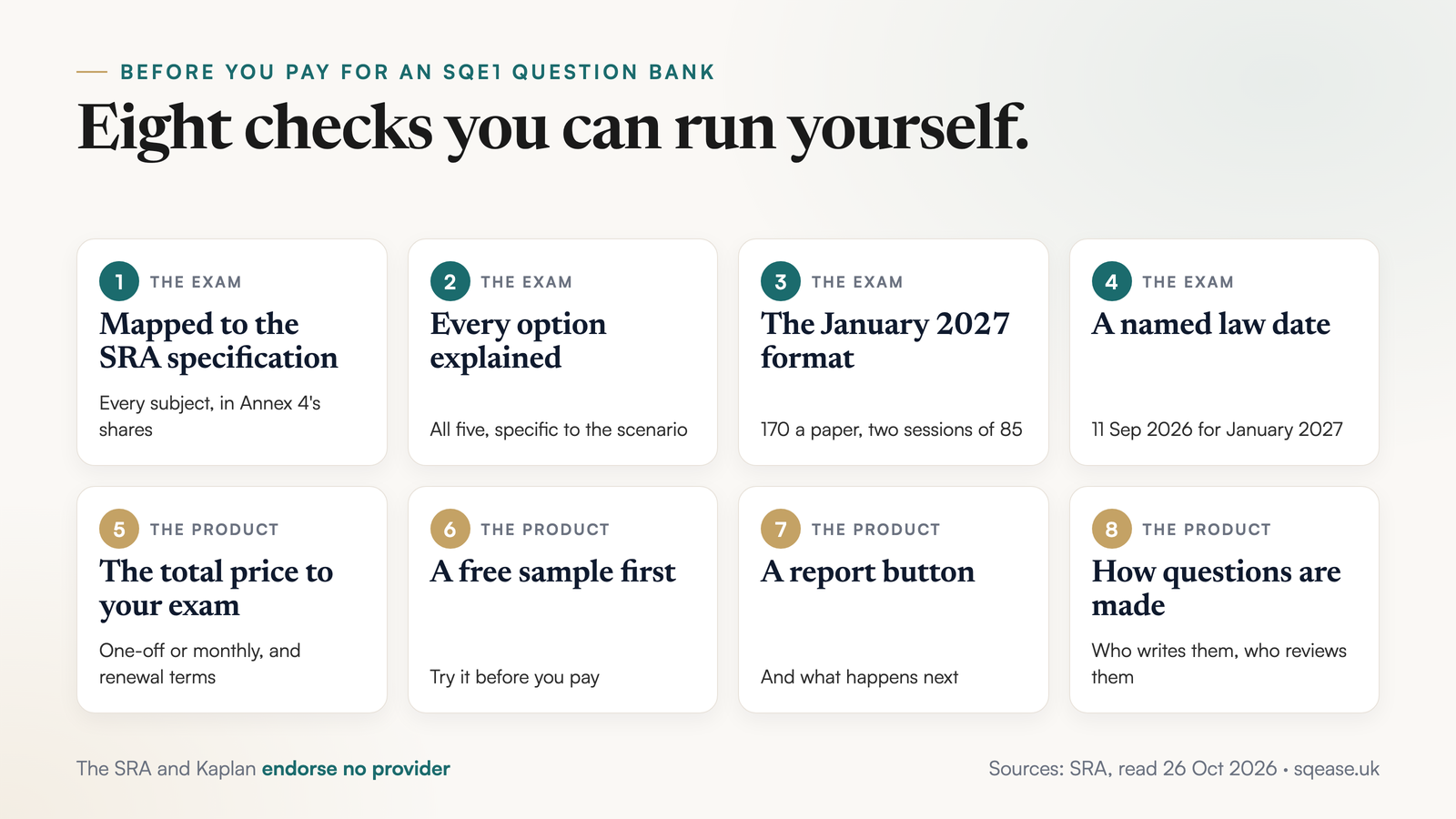
Several providers offer a free SQE1 mock or diagnostic, each built for a different job. The table lists what each provider's own page said on 26 October 2026. We have not taken or tested the others, and "not stated" means the page does not say.
| Provider | Free questions | Timing | To start | Feedback after |
|---|---|---|---|---|
| SQEase (ours) | 45, three from each of 15 subjects | 108 s a question | SQEase account | A written report: patterns across subjects, pace on each question, changed answers, steps with targets |
| FQPS | One FLK1 and one FLK2 mock, each 2 × 85 | Not stated on the homepage | Free account | Not stated on the homepage |
| QLTS School | 50 per paper (live test) | 2 h 33 min, can be paused | From the page | Explanations of every option; topic breakdown |
| BPP | 100 (one FLK1 mock) | No timer shown | No sign-up | Pre-set feedback on results |
| LexIQ | 58 across 8 subjects | 90 minutes | No account | Score by subject area; explanation on every answer |
| Lawdojo | 25 (FLK1 or FLK2) | About 1 min 42 s a question | Free account | Score, areas costing marks; worked answers |
| ActusPrep | 100 diagnostic questions | Not stated | Not consistent across its pages | Instant feedback and an email report |
| The Qualified Path | 30 across 13 subjects | 50 minutes | No registration | Subject breakdown |
| THEONEHUNDRED | Not stated | Not stated | Not stated |
For a free paper-length rehearsal, FQPS and QLTS publish the longest free tests; for questions without an account, the SRA's 220 sample questions are the place to start. The calibration mock is built for a different job: one sitting across every subject, read for patterns.
Questions candidates ask
Is the calibration mock free?
Yes. It is in every SQEase account. You need an account so your progress can be saved if you pause, and so the report can be kept on your Home page and sent to you.
Can I take it on my phone?
Not yet. For now the mock is on the SQEase website, and it works best on a computer. The iPhone app will get it in a later update.
How does it compare with a real SQE1 paper?
From January 2027 each SQE1 paper is 170 questions in two sessions of 85, according to the SRA. The calibration mock is a 45-question sitting at the same average pace, designed to read every subject at once and find patterns, so it is a starting point for your plan rather than a rehearsal of a full paper.
Can the report predict my SQE1 result?
No, and it does not try. It shows where your marks went in one sitting and what to practise next, with a target for each step so you can check your progress.
To take the calibration mock, open SQEase on your computer: it is at the top of your Home page, or at sqease.uk/app/calibration. New to SQEase? Create an account, and setup ends with the mock.
How this was written: Finlay Salisbury wrote and edited this post. AI tools helped with research and drafting. Every legal and factual point was checked by him against the linked primary sources. He is not a solicitor, and this is study information, not legal advice.
Disclosure: I run SQEase, a paid SQE1 practice platform, so I have a commercial interest in how candidates prepare. The table of other providers lists only what each states on its own page, and does not rank or review them. SQEase practice questions are written by AI and checked by automated multi-model processes. They are not reviewed by a solicitor and are not SRA or SQE1 exam questions. Spotted an error? Email hello@sqease.uk.